

Iyioluwa Adesan
Founder and CEO, Apprentis · Apprentis Research & Insights
Introduction
A Founder's Note
I was dropped from my IT course during sixth form, which meant I no longer met the entry requirements for the university degree route I had intended to pursue. Even if I had met those requirements, university was not financially realistic. The cost was beyond what I could afford.
I later joined NatWest Group's first Digital & Innovation Degree Apprenticeship cohort, studying Digital & Technology Solutions at BPP University while working full time. I was able to earn while studying and graduated without taking on student-loan debt.
That experience shaped the questions Apprentis asks. My own route explains why I care about them; it does not form part of the evidence base for this synthesis.
When we began The Systems Behind the Pathway series, I did not want to assume that one organisation, including ours, could see the whole transition from education into employment. I asked five practitioners, each working at a different point in the system, to describe what they see, where pathways break down and who is able to respond.
This synthesis is our attempt to read those conversations together. What I took from them was a sharper set of questions. It examines where pathways work, where they fail and, when a gap becomes visible, who can act on it.
This is Apprentis's interpretation of five perspectives, not a consensus among the contributors, a universal model or a set of settled conclusions. Apprentis also has a direct interest in how readiness is understood and measured. Readers should take that into account when assessing our interpretation.
I hope it helps you examine your own role in the pathway and challenge what we have written.
Iyioluwa AdesanFounder and CEO, Apprentis
Overview
Executive summary
The central reading

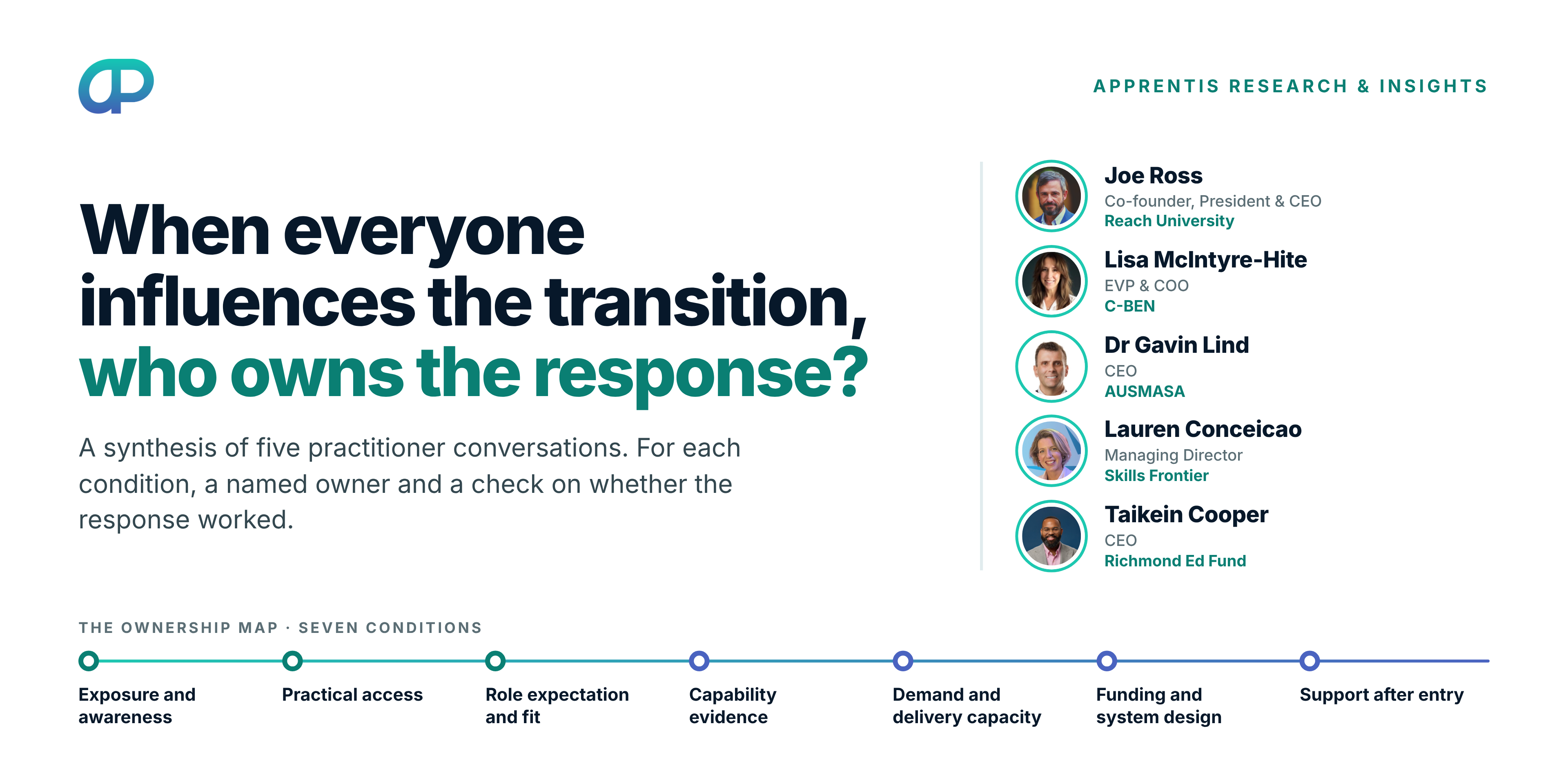
We reached this reading by comparing five conversations with practitioners at different points in the system: Joe Ross on pathway design, Lisa McIntyre-Hite on evidence of capability, Dr Gavin Lind on workforce demand, Lauren Conceicao on cost, authority and risk, and Taikein Cooper on access and support. Five themes recur:
- A pathway needs an operating model: clear purpose, credible learning, sustainable funding and coordinated delivery.
- A credential is not evidence of capability. Evidence has to be interpretable and portable without losing context.
- Workforce intelligence has to reach training capacity and career decisions before a vacancy becomes urgent.
- Awareness is not access. Transport, equipment, relationships, role expectations and support after entry decide whether a pathway is usable.
- Shared responsibility needs a lead for each condition, with the authority and resources to act.
A readiness signal has practical value only when it is read in context, reaches someone able to act and can be followed through to an outcome. The ownership map in this report is our interpretation and a hypothesis for us to test, not a finding.
Method
Scope and method
This synthesis brings together five published conversations and their companion articles. We interviewed practitioners positioned in different parts of the education-to-employment system. They are not a representative sample, and apart from the shared closing question about what should become more visible before someone enters work, the conversations did not use an identical question set.
Three contributors are US-based (Joe Ross, Lisa McIntyre-Hite and Taikein Cooper) and two are Australia-based (Dr Gavin Lind and Lauren Conceicao). Lauren Conceicao's conversation also compares aspects of the UK and Australian apprenticeship systems. No UK-based employer, provider or policymaker was interviewed.
To find the themes, we read the five interviews and companion articles side by side, noted where the same question recurred in different forms and where the accounts pulled apart, and grouped what we found. We did not use formal coding or a systematic analysis method.
We distinguish four kinds of statement: contributor accounts (what a participant said from their professional position), external sources (published figures or policy rules that can be checked), our interpretation (what the accounts may imply when read together) and open questions (what the conversations raise but do not resolve). Two external evidence bases are used: AUSMASA's research bulletin [S1] and the England funding rules for 2026 to 2027 [S2, S3, S4]. Everything else rests on the conversations themselves.
This is a structured editorial synthesis, not a systematic review, representative survey, programme evaluation or causal study. It identifies themes and tensions for further investigation. It does not estimate how common a problem is or prove that an intervention works.
The five conversations

- 01
Joe Ross [E1]
Co-founder, President and CEO, Reach University (US)
Pathway design and durability
A job can be designed as part of a learning pathway. Durability depends on shared definition, reliable funding and coordinated change.
- 02
Lisa McIntyre-Hite, Ph.D. [E2]
EVP and COO, Competency-Based Education Network (US)
Capability and evidence
Competency can connect learning and work when the evidence behind it is credible, interpretable and portable.
- 03
Dr Gavin Lind [E3]
CEO, Mining and Automotive Skills Alliance, AUSMASA (Australia)
Workforce demand and supply
A vacancy is a late signal. Demand intelligence must connect to training capacity, career choices and progression for the current workforce.
- 04
Lauren Conceicao [E4]
Managing Director, Skills Frontier (Australia)
Governance, cost and accountability
Readiness is shaped by several parties. A failing pathway should be diagnosed by condition before responsibility is assigned.
- 05
Taikein Cooper [E5]
CEO, Richmond Ed Fund (US)
Access, relationships and progression
Knowing a pathway exists does not mean someone can enter it. Exposure, practical support, relationships and help after entry matter.
Findings
Five recurring themes across the conversations
The contributors did not set out to agree. The themes below are our reading of where their accounts meet. They are recurring questions across five perspectives, not findings about how common these conditions are across education or employment systems.

1.A pathway needs an operating model, not just a label
Joe Ross's working definition of an apprenticeship degree has three elements: affordability, a workplace basis and credit for learning at work. He argues that the model must be understood clearly before it can be funded, implemented or scaled, and names sustainable funding and coordinated change across employers, education institutions and policymakers as conditions for durability. [E1]
An important qualification sits inside his own account. The ABC framework helps distinguish an apprenticeship degree from conventional higher education, but those features do not by themselves distinguish it from apprenticeship more broadly. It is a working definition for the model he describes, not a universal definition of every apprenticeship.
The wider implication is that a pathway is more than its title or qualification. Its operating model includes who pays, where learning takes place, how workplace learning is recognised, what progression it supports and whether the institutions involved can sustain delivery.
2.Capability needs evidence that can travel
Lisa McIntyre-Hite separates five ideas that are often collapsed into the word credential. The credential records completion. Competency describes what a person knows or can do. Evidence shows how that capability has been demonstrated. A signal is what another party can reasonably understand from the evidence, and a decision is what follows when the signal is used. [E2]
- Credential
- Competency
- Evidence
- Signal
- Decision
The sequence matters because completion alone does not establish what someone can do at work. Evidence cannot be made portable simply by stripping away context either. Her example of compassion in nursing shows why: the underlying competency may be recognisable across settings while its observable expression differs by context.
The design tension is not between measurement and no measurement. It is between evidence consistent enough to interpret and evidence rich enough to represent the capability being assessed. A rigid checklist can miss genuine capability. A loose description can produce signals that different people read differently.
3.Workforce planning starts before the vacancy and includes the current workforce
Dr Gavin Lind argues that a vacancy is a late-stage signal. Training systems need time to respond to changing demand, build teaching capacity and make routes into relevant work visible. He also places the current workforce inside the planning question: experienced workers may hold capabilities that can be recognised and developed towards new roles. [E3]
AUSMASA's January 2026 Mining Research Bulletin reports that Australian mining-engineering degree enrolments fell from 2,420 in 2014 to 770 in 2018, a 68% decline, and that completions fell by 65% over the same period. [S1] The bulletin notes that enrolment figures are rounded to the nearest five and may understate actual numbers. These are pipeline indicators for one sector. They are not a count of unfilled vacancies and should not be generalised to other industries or countries.

The example makes the timing problem concrete. A demand signal is useful only if it can influence decisions about training supply, delivery capacity, recruitment and progression early enough for those decisions to matter.
4.Access depends on conditions before and after entry
Taikein Cooper distinguishes awareness from access. A student may know an opportunity exists and still be unable to reach it, picture themselves in it or understand the next step. He describes practical barriers including transport, starter tools, protective equipment and counselling, alongside early exposure and relationships that can provide information, encouragement and introductions. [E5]
He also describes a missing middle between formal education and the everyday expectations of work, and discusses durable skills such as punctuality, professional communication and confidence in workplace interactions, while recognising that these do not remove structural barriers such as inaccessible transport or weak workplace support.
This matters for readiness assessment. A learner may be motivated and capable but unable to participate because the conditions are missing, and recording a learner deficit would then misdiagnose the problem. The series does not establish that early exposure or a particular life-readiness course improves employment outcomes. Those remain questions for evaluation.
5.Shared responsibility needs condition-level accountability
Lauren Conceicao describes an apprenticeship as involving at least the learner, employer, training institution and government, with parents or guardians also shaping the decision for younger learners. Each party sees different risks and holds different authority. Her central warning is that shared responsibility can make responsibility untraceable when no one is accountable for a specific condition. [E4]
Her comparison of Australian and UK arrangements is a practitioner's account of design trade-offs. She describes Australia's qualification-centric, highly regulated structure as supporting consistency while potentially slowing adaptation, and parts of the UK system as more flexible while raising questions about what each apprenticeship promises. It does not establish that either national model is better or that a feature can be transferred successfully.
The practical lesson is to diagnose the constraint before choosing an intervention. A taster may help when role expectations are inaccurate, but it will not create more placements. Better onboarding may improve supervision, but it will not fix a funding rule or a shortage of teaching capacity. Different causes need different response owners, and the table later in this report sets out our reading.
Tensions
Where the conversations create tensions
The contributors were not interviewed together and were not asked to respond to one another. The points below are tensions between their accounts, not recorded disagreements.

- Consistency and context
- McIntyre-Hite's case for credible, portable evidence depends on some consistency. Her warning about rigid checklists shows why consistency cannot mean removing the context in which capability is demonstrated.
- Flexibility and comparability
- Conceicao's comparison raises a recurring design question: flexible routes can adapt to particular roles, while more standardised structures can make qualifications easier to interpret. Neither guarantees quality.
- Visibility and capacity to respond
- Lind's early workforce signals, McIntyre-Hite's capability evidence and Cooper's access indicators can make a gap visible. None creates teaching capacity, transport, supervision or authority to act by itself.
- Reported value and demonstrated value
- Ross argues that apprenticeship degrees should be judged by return on investment, and reports employer-level outcomes such as a Texas school district that stopped external teacher recruitment. Conceicao is more cautious: her own cost comparison is a framing, not a like-for-like costing, and she says a funding trend would need data by level, occupation and year. We have not been able to verify these claims, so we attribute them and do not repeat the headline figures. [E1, E4]
Ownership map
Who owns the response, and what to check
The potential owners are the least surprising part of this map. The value is in the check: for each condition, the question that shows whether a response worked. Without that check, a pathway can fill with activity and still leave the gap open.

Exposure and awareness
What to check
Did the person receive meaningful exposure, understand the next step and have a route to follow up?
Example raised in the series
A young person has not encountered or understood an occupation. [E5]
Potential response owner(s)
School, careers service, employer, community partners
Practical access
What to check
Was the barrier identified, who agreed to remove it, and could the learner participate afterwards?
Example raised in the series
Transport, tools, protective equipment or counselling are missing. [E5]
Potential response owner(s)
Whichever party can remove the specific barrier: employer, provider, school, community partner or funder
Role expectation and fit
What to check
Were expectations made realistic before entry, and was early support available when the role differed from them?
Example raised in the series
A prospective apprentice does not understand the day-to-day reality of the work. [E4]
Potential response owner(s)
Employer and training provider, with the learner involved
Capability evidence
What to check
Can the evidence be interpreted, does it keep relevant context, and is it used in a real decision?
Example raised in the series
A credential does not show what the person can do. [E2]
Potential response owner(s)
Education provider and employer, with the receiving institution involved
Demand and delivery capacity
What to check
Did the demand signal reach those setting training capacity, and did delivery or progression change?
Example raised in the series
Workforce demand and the education pipeline move out of alignment. [E3, S1]
Potential response owner(s)
Industry and skills bodies, providers, universities and TAFEs, policymakers
Funding and system design
What to check
Who pays, who carries risk, which routes receive funding, and what evidence supports the allocation?
Example raised in the series
Cost, risk or funding route is unclear or misaligned. [E1, E4]
Potential response owner(s)
Government and funding bodies; employers and providers implement the rules
Support after entry
What to check
Was support offered, did the working or learning condition change, and what happened next?
Example raised in the series
Weak supervision, disengagement or the missing middle. [E4, E5]
Potential response owner(s)
Employer and training provider, with the learner's perspective included
How to read this map
Practical test
A practical test for any readiness signal
Information is not useful simply because it has been collected. Before a readiness signal is acted on, the receiving organisation should be able to answer:

- What condition does the signal indicate, and what evidence supports that interpretation?
- Whose perspective is missing, and what context is needed to interpret the signal fairly?
- Who needs to receive it, and who has the authority and resources to respond?
- What action is expected, who is responsible for it and by when?
- What outcome will be checked, and what happens if the response does not work?
Implications
What this asks of you
These are our suggestions, drawn from what the contributors described. They are not recommendations the contributors made. For each audience we give two actions and the check that shows whether they worked.

Schools and colleges
- For each pathway you promote, name what a student would need to reach it (transport, equipment, a contact at the employer, a realistic picture of the work) and who removes each barrier.
- Treat the first months after entry as part of your remit where you can. Find out what happens to students after they start, and who tells you.
Check
Can a student who hears about a pathway take a supported next step, and who helped them?
Employers
- Plan for an apprentice as an investment in development, not immediate productivity, and make supervision and early support explicit.
- Be specific about the capability a role develops and how it will be evidenced, so that the evidence can travel with the person.
Check
When an apprentice struggles, can you tell whether the cause is the role, the supervision, the training or the individual?
Training providers and universities
- Show what completion demonstrates: link each credential to competencies and observable evidence, keeping the context in which they were shown.
- Give prospective learners an honest picture of the work, including its less attractive realities, before they commit.
Check
Does your evidence tell an employer what a graduate can do, and would another institution read it the same way?
Funders and policymakers
- Fund the conditions as well as the places: transport, equipment, supervision and delivery capacity.
- Ask programmes to show who was accountable for each condition and what changed, not only starts and completions.
Check
If a programme under-delivers, can you tell which condition failed and who could have acted?
Our position
What this means for Apprentis
The conversations give us design questions, not endorsements or proof that a particular readiness framework works. Taking part in the series does not imply that a contributor has approved our approach. The implications below are ours.
- Readiness information should not become a verdict on the person. A gap may sit with the learner, workplace, provider, pathway design, funding arrangement or wider system.
- We want the condition to be visible, not only the score. A useful signal should preserve who observed it, where, when and in what context.
- A signal needs a recipient and a response owner. If no one has the authority or resources to act, the information may describe a problem without changing it.
- Diagnosis and intervention are separate steps. An awareness gap, a transport barrier, weak supervision and an evidence problem should not trigger the same response.
- Relationships are a resource, not a score. Cooper's question about social capital is unresolved for us too, and counting contacts would not establish the quality or usefulness of support.
- Readiness continues after entry. The series repeatedly raises role fit, supervision, development and progression as part of the transition.
We should be able to trace the diagnosed condition, the action taken and the outcome observed before we claim that readiness intelligence improved a result.
Open questions
Five questions for further research
- Signal transfer
- When one organisation sees a gap and another can act, what carries the signal across, and who is accountable if it does not arrive?
- Evidence
- What makes capability evidence credible and portable without removing the context needed to interpret it?
- Timing
- Which early workforce indicators reliably precede a shortage, and how do they change training and teaching capacity?
- Access and support after entry
- Which practical barriers and post-entry supports matter most for taking up and staying in a pathway, and how should their effect be evaluated?
- Transfer
- Which features of apprenticeship models travel between jurisdictions, and which depend on local funding, governance and labour-market conditions?
Next stage
What we do next
We want to widen the evidence base beyond senior system leaders. That means hearing directly, and with a stated method, from apprentices and students, parents or guardians where relevant, line managers, front-line employers and UK providers.
We also intend to test the working map against real pathway cases: what was observed, who received the signal, what action followed, whether the condition changed and what happened to the learner or worker afterwards. That would show whether our interpretation holds beyond these five conversations. Until then, we offer it as a working account, and we welcome challenge.
Limitations
What these conversations can and cannot support
Five conversations are enough to surface questions worth testing. They are not enough to settle them. We set out the boundaries so that readers can judge how far to rely on what follows.

- Five vantage points, not a sample
- The contributors cover different parts of the system, but they do not represent all learners, employers, providers or policymakers. We read them as perspectives, not as measures of how common a condition is.
- Geography
- Three contributors are US-based and two Australia-based. No UK-based interviewee took part, although one conversation compares UK and Australian systems and the funding context covers England. The interviewer and author is UK-based and our questions were framed from a UK vantage point, but that shapes what we asked. It does not add a UK contributor's evidence, so closing that gap is part of our next stage.
- Voices still to come
- No apprentice, school student, parent or line manager was interviewed for this series. Apprentis publishes separate UK apprentice stories [S5], which inform our thinking, but they were not gathered as research, their selection and collection method is not stated and we do not use them as evidence here. We want to bring these voices in directly and with a stated method.
- Association, not causation
- The conversations do not show that early exposure, competency frameworks, apprenticeship degrees or readiness diagnostics cause better outcomes. We treat these as hypotheses to test.
- Contributor claims
- Several numerical and outcome claims come from the contributors' own accounts. We attribute them and have not independently verified them. The evidence register shows which claims are which.
- Transferability
- US and Australian examples may not apply directly to the UK or to other sectors. We use them to sharpen questions, not as templates.
- Our position
- Apprentis selected and framed the series, produced this synthesis and has a stake in how readiness is measured. The contributors reviewed our interpretation before publication, which does not mean they endorse it, and we have not tested it independently. We have tried to separate what was said from what we infer, so that readers can challenge the second.
Evidence
Evidence register
Mining-engineering enrolments fell from 2,420 (2014) to 770 (2018), a 68% decline; completions fell 65% over the same period.
Evidence status
External source: AUSMASA bulletin, January 2026. [S1]
How we treat it
Used as a sector-specific Australian pipeline example. Enrolments are rounded to the nearest five and may be understated. Not a vacancy count or a universal trend.
England apprenticeship funding rules for starts from 1 August 2026.
Evidence status
External sources: GOV.UK publication page, employer guidance and rules PDF. [S2, S3, S4]
How we treat it
Used to describe the applicable policy conditions. Not evidence of actual funding allocation by level or occupation.
Employer return on investment from an apprenticeship degree, as stated in the Ross interview.
Evidence status
Contributor account: Joe Ross. [E1]
How we treat it
Not independently verified. No underlying calculation is supplied, so we do not repeat the figure.
A Texas school district reportedly stopped external teacher recruitment after two to three years of its pathway.
Evidence status
Contributor account: Joe Ross. [E1]
How we treat it
Retained as an attributed example with no independent corroboration.
Cooper's estimate of how many US K-12 systems behave as if responsibility ends at graduation.
Evidence status
Contributor estimate: Taikein Cooper. [E5]
How we treat it
His own estimate, not an independently verified national statistic. Not used as a prevalence finding, and we do not repeat the figure.
UK levy funding has moved towards higher-level and executive programmes.
Evidence status
Contributor observation: Lauren Conceicao. [E4]
How we treat it
Not established as a national trend. Testing it needs starts and allocation data by level, occupation and year.
Apprentice stories published by Apprentis (eleven UK apprentices, Vol. I, 2026).
Evidence status
Apprentis-published testimonials. Selection and collection method not stated. [S5]
How we treat it
Illustrative context only. Not used as evidence and not treated as representative.
Appendix A
England funding context (reviewed 24 November 2026)
The rules apply to apprenticeship starts in England between 1 August 2026 and 31 July 2027. [S2] For eligible apprentices aged 16 to 24, the government funds all training and assessment costs up to the funding-band maximum where the employer does not pay the levy, or pays the levy but has run out of funds. For apprentices aged 25 or over, the government contributes 95% for non-levy employers and 75% for levy payers who have run out of funds, and the employer covers the balance. [S3, S4]
These provisions depend on levy status, available funds, age at start and start date, apply to England only and are subject to the funding-band maximum. They should not be paraphrased as all under-25 apprentices receiving full funding.
The rules give policy context for the funding discussion in Conceicao's interview. They do not show how funding is actually distributed across levels, occupations or programme types, and they do not show whether the pattern she described is occurring nationally. That would need data on starts, funding allocation and employer contributions by level, occupation, employer type and year.
References
Sources and further reading
Episode articles
- [E1]Joe Ross
- [E2]Lisa McIntyre-Hite
- [E3]Dr Gavin Lind
- [E4]Lauren Conceicao
- [E5]Taikein Cooper
External sources
- [S1]Mining and Automotive Skills Alliance (AUSMASA), “Mining Research Bulletin, January 2026” (published 13 January 2026)
- [S2]GOV.UK, “Apprenticeship funding rules: 2026 to 2027” (publication page; England only; starts 1 August 2026 to 31 July 2027)
- [S3]Department for Work and Pensions / GOV.UK, “Apprenticeship funding” (employer guidance for England, starts from 1 August 2026)
- [S4]“Apprenticeship funding rules: 2026 to 2027”, version 3 (PDF, 176 pages)
- [S5]Apprentis, “Apprentice Stories”, Vol. I, 2026 edition (context only; not used as evidence in this report)
Sources S2 to S4 together support one evidence base, the England funding rules. S5 is context, not evidence. Funding rules and guidance were checked against GOV.UK on 24 November 2026.
Series note
This synthesis is our reading of five conversations in The Systems Behind the Pathway. It reflects the contributors' professional accounts and does not imply that they agree with one another or endorse our interpretation or products. It is not a representative study or programme evaluation, and it is not the Apprentis Thesis, which is still in development.
Prepared by Apprentis Research & Insights. Published 26 November 2026.